

In summer 2025, we published Understanding Demand for Retrofit, a literature review developed by our Driving Uptake Working Group (WG6), supported by The MCS Foundation. The review brings together existing insight into what shapes decision-making around retrofit and highlights the emotional, financial, and practical barriers that continue to hold people back.
It challenges the idea that demand is simply a matter of choice. Instead, it shows that a series of conditions must be in place before someone is ready to act. Despite the clear benefits of retrofit, uptake remains stubbornly low. Fewer than 100,000 heat pumps were installed in 2024 against a target of 600,000 a year, and only two in five homeowners are actively considering improvements.
To move beyond the idea of a single “yes/no” moment, the report introduces a straightforward yet powerful framework:
- Awareness – recognising the need for change and knowing what support exists
- Attitude – how people feel about retrofit and the organisations delivering it
- Ability – whether people have the means, confidence or support to act
- Appropriate Trigger Point – the moment or event that prompts a decision
This framework will underpin the next phase of WG6’s work.
What WG6 will focus on in 2026
Our goal is to turn the theory into practical outputs the whole sector can use.
1. Mapping the landscape across three levels
We will begin with a collective mapping exercise across the full system:
- Macro – e.g. local authorities, asset managers, and area-based delivery
- Micro – e.g. neighbourhoods and community-led engagement
- Solo – e.g. individual households making one-off decisions
This will look at customer profiles, levels of readiness, decision points, key channels of engagement, and the different places where influence sits.
2. Selecting three priority segments
Together, we will then choose three segments where deeper exploration will add the most value. Each will be explored in more detail through workshops that will:
- Apply the 4A framework
- Map barriers, needs and enablers
- Identify what’s already happening
- Surface gaps where new work is needed
- Highlight quick wins the sector can support straight away
3. Co-creating project briefs
This detailed work will feed into co-created project briefs for each segment. These will outline where shared resources, or guidance, could help and highlight policy recommendations.
HEAT-AS-A-SERVICE
Alongside this, we will continue supporting the development of Heat-as-a-Service as a financial enabler for retrofit and decarbonisation, building on work led by LSBU. A dedicated HaaS Strategy Board, which includes WG6 Co-chair Pippa Palmer, will help ensure this strand aligns with our wider programme.
MEET OUR NEW CO-CHAIRS
We’re delighted to welcome:
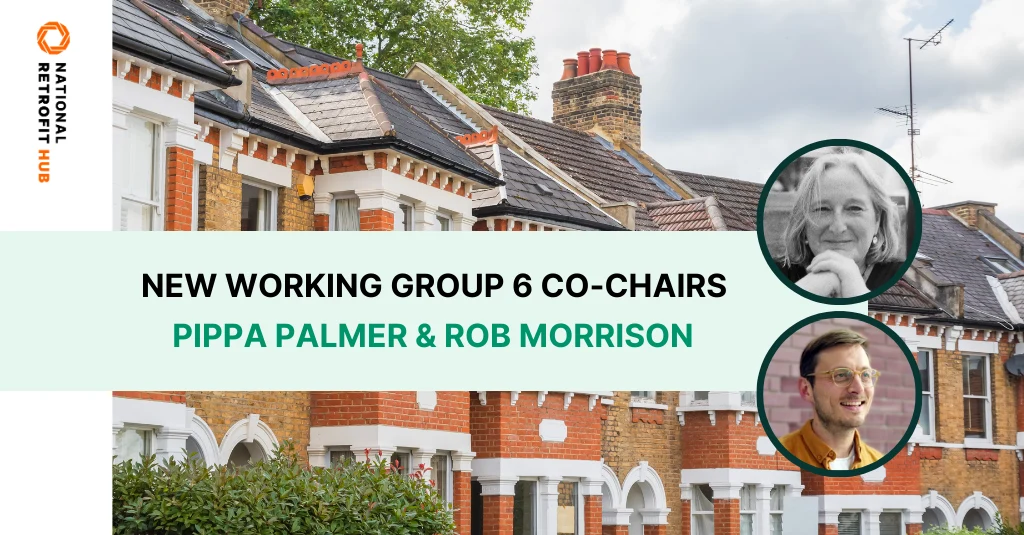
Pippa Palmer – Co-Chair
Pippa Palmer is Senior Strategic Lead for Systems Change for Retrofit at LSBU’s Building Future Communities Research Centre and Founder of research consultancy Polln. She brings wide experience in behavioural insights, market development and large-scale decarbonisation programmes, including previous leadership at SolarAid. Her work focuses on the whole retrofit ecosystem including skills, organisational readiness, community engagement and funding frameworks, and she recently co-chaired NRH’s Workforce Growth and Skills Group.
“I am thrilled to be taking this new Co-Chair role. Retrofit is a critical link in breaking the fossil fuel dependence that is harming our nation’s health and wealth and our planetary future. But we cannot address the technical and economic challenges of decarbonisation without resolving the other end of the problem – how to make retrofit an intuitive, safe and affordable choice for every household held back by a poorly performing home.”
Rob Morrison – Co-Chair
Rob Morrison is Impact Manager for retrofit at BE- ST and Executive Director at Agile City CIC in Glasgow. His background spans architecture, community led development and setting up platforms for learning and enterprise. He has delivered practical retrofit projects including Civic House, a prototype energy positive deep retrofit of a post industrial building, and now leads work on Retrofit Scotland and industry engagement through the Centre for Net Zero High Density Buildings.
“I am delighted to be co-chairing working group 6 for the National Retrofit Hub, working closely with Pippa Palmer, NRH leadership, and working group members. I am excited to bring my practical experience of delivering the full life cycle of retrofit projects alongside setting up collaborative platforms and enterprises to drive place based and mission led change. I hope to link the wealth of experience of the NRH with a practical mind set to create meaningful opportunities to test ideas through action.”
Pippa and Rob will help guide WG6’s direction, shaping the programme and supporting the wider group.
JOIN US: YOUR INSIGHT IS NEEDED
We are inviting anyone working across retrofit, behaviour change, community engagement, housing, finance, policy, research or delivery to join us for our first open session:
Monday 3rd February
12:00–13:30
Open Mapping Workshop – help us map the market across macro, micro and solo levels
This session is open to all and requires no ongoing commitment.
After this, we will be inviting expressions of interest from people who would like to be more involved in the deeper workshop sessions. You are very welcome to take part at a high level only if that suits you better. The group will benefit from a mix of both.
Sign up to attend here.

