

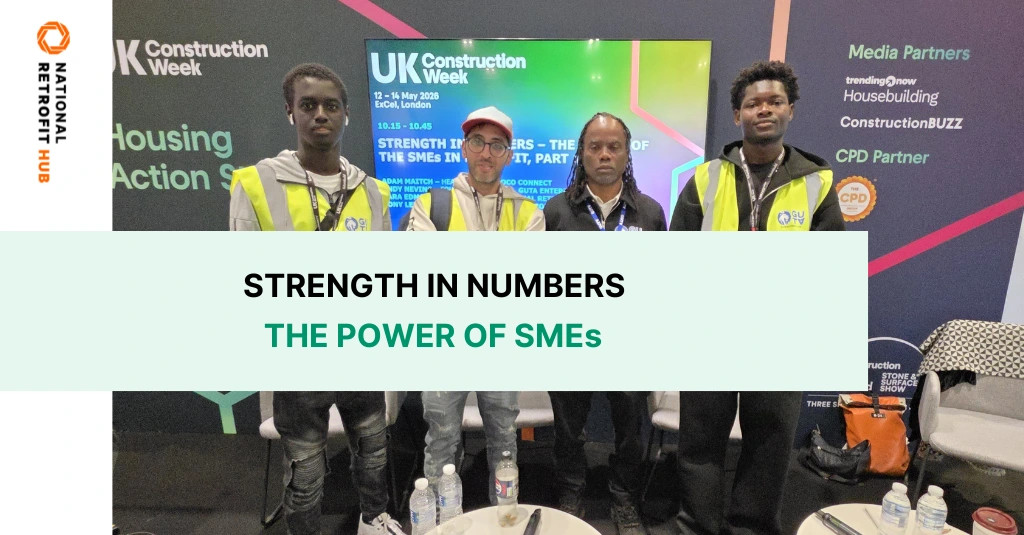
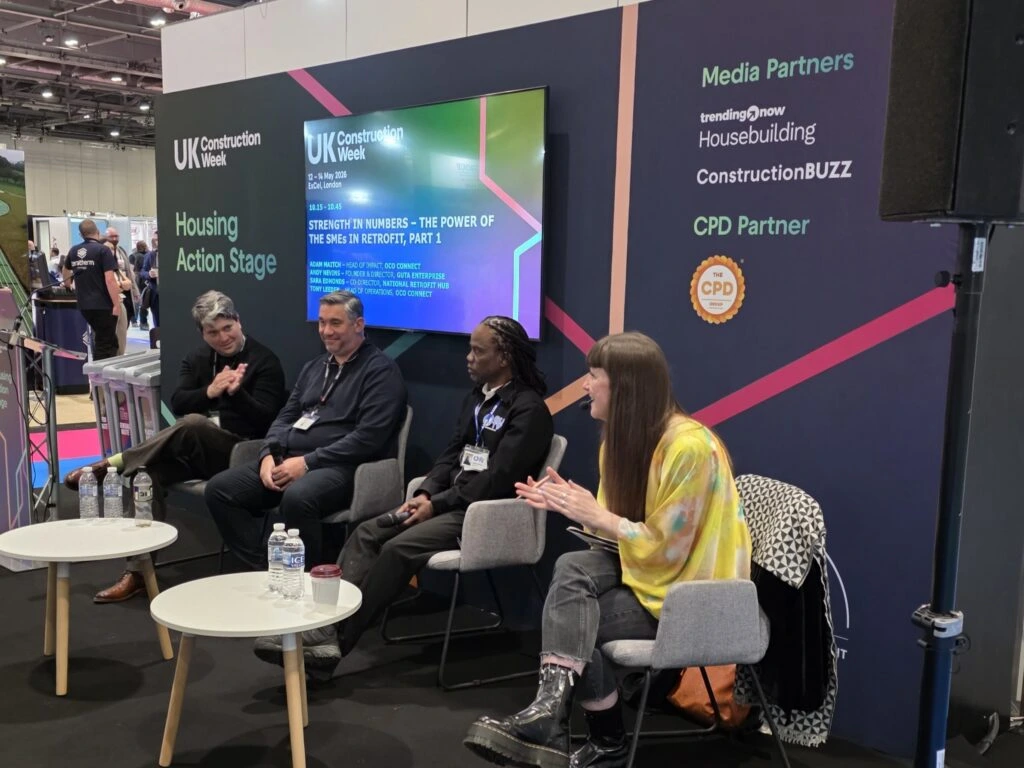
‘Strength in numbers: the power of SMEs’, the UKCW panel hosted by Sara Edmonds, turned out to be an inspiring display of diversity of thought and inclusivity. A real beacon of hope for what can be achieved when people ‘give it a go’ and ‘see it through’.
The panellists were Adam Matich and Tony Leeden from OCO Connect, alongside Andy Nevins from Guta Enterprise CIC. Between them, they represented the kind of organisations retrofit already relies on every day. Businesses and community organisations rooted in local places, employing local people, creating opportunities, and trying to make the system work better for others as well as themselves.
I was inspired by the way they talked about their work and the way they approached the discussion. There was openness, and a real willingness to share what they had learned with others. It felt collaborative rather than competitive, with a strong sense that they wanted to bring more people with them and help others succeed.
Because SMEs already deliver a huge amount of retrofit work across the country, they also deliver a huge amount of the social value attached to it. The challenge is that the systems wrapped around retrofit delivery still make it unnecessarily difficult for many of those organisations to access opportunities in the first place.
THE REALITIES ON THE GROUND
Adam talked openly about the realities of trying to compete as an SME. Financial thresholds favouring larger organisations with bigger groups behind them. Lot sizes built around prime contractors. Accreditations that are expensive to obtain and even more burdensome to maintain. Tender submissions running into hundreds of pages and requiring resource that many smaller businesses simply do not have.
“I was working on a tender last week, 200 pages long,” Adam said. “You fight through all of those barriers, you might win the work, and then you’re third or fourth in the chain with your margins reduced as a result.”
Andy sees the impact of that directly. The work often goes through a larger contractor first, even though the actual delivery still depends on SMEs with the workforce, local knowledge and practical capability to carry it out.
Tony raised another important point around where value ends up sitting once multiple layers are added into the chain. The organisations closest to the work and closest to the community are often operating on the tightest margins, despite carrying so much of the responsibility for delivery and engagement.
What came through strongly across the discussion was that social value is already happening within these organisations, whether it is formally labelled that way or not.
Local workforce. Local suppliers. Apprenticeships (not easy to support as an SME). Supporting young people into construction and retrofit careers. Working with colleges, councils, housing associations and churches on local projects. Keeping skills, opportunity and investment within communities rather than extracting it away from them.
STRENGTH IN NUMBERS – A COLLECTIVE APPROACH
Part of the reason OCO Connect was created was to help SMEs better articulate and evidence the social value they are already delivering, helping organisations navigate frameworks and procurement processes while staying connected to real community impact.
Adam described their consortium approach bringing together contractors, architects, specialist trades and Tier 1 organisations to share knowledge, back-office support, accreditation understanding and opportunities to collaborate.
I really admired that approach. There was ambition there, but also a strong sense of responsibility towards other SMEs and other communities. Adam spoke about Tony leading the way by bringing people together and not feeling the need to have every answer already worked out before starting. There was a theme throughout the discussion of people trying things, learning together and building models collaboratively rather than waiting for perfect conditions.
Andy brought three of his apprentices with him to the panel, which probably demonstrated his point more clearly than anything else said during the discussion.
Guta Enterprise CIC works directly with young people, helping them access training, construction experience and long-term opportunities within the sector. Andy spoke passionately about supporting people properly and staying committed to them beyond the basics of training alone.
Picking them up. Dropping them home. Helping them stay engaged. Giving them confidence as well as skills. “I don’t quit on what I do. I follow through.”
You could really feel the passion and commitment behind what Andy, Adam and Tony were talking about. They are not simply talking about change, they are building things, connecting people and creating opportunities right now.
CREATING A LEGACY
One part of the discussion that particularly stayed with me was Andy talking about legacy and linking this back to his own Jamaican heritage.
“Bob Marley passed his legacy down. Usain Bolt passed his legacy down. Now I want to do that. Teach them construction. Teach them surveying. Train them from scratch. Make sure I support them. Pass down my legacy”.
That mindset ran through the whole discussion. Helping other people succeed. Creating the conditions for others to grow. Asking communities what they actually need rather than deciding on their behalf.
Andy spoke about the importance of involving communities properly in shaping what social value should look like locally. What would genuinely help people? What opportunities would make a difference? What support is actually needed?
AUDIENCE ENGAGEMENT
There was also an important audience question around the single thing that would make the biggest difference for SMEs trying to access retrofit opportunities.
Adam talked about the impact fair payment terms could have, with SMEs often carrying huge pressure while waiting for payments to move through long supply chains. Minimum thresholds and financial requirements were also raised by Tony throughout the discussion, with many frameworks still designed in ways that naturally favour larger organisations.
The conversation made me think a lot about how many good organisations and capable SMEs are probably sitting just outside the system, not because they cannot deliver, but because the barriers to entry have become so difficult to navigate.
Adam also shared how the OCO Connect consortium originally came together through a short-notice email asking whether people wanted to be involved. The response was overwhelming and the follow-up session quickly evolved into people sharing why they wanted to contribute and what they were trying to build in their own areas.
That willingness to bring people in and create opportunities for others felt very different.
THE ROLE OF THE NRH
I asked how the National Retrofit Hub can support this work further because there is clearly something important happening here. We will be developing more detailed case studies around the work these organisations are doing and the models they are building. But there are bigger questions as well.
How do we help scale approaches like these? How do we make it easier for SMEs to participate meaningfully in retrofit delivery? How do we find and connect more organisations that want to learn from these models and adopt similar approaches within their own communities?
Because scaling retrofit delivery is not only about funding, frameworks and targets. It is also about creating systems where good organisations can participate properly, collaborate effectively and continue building long-term value within the communities they already serve.

